Shopping Cart



In stock, ready to be shipped
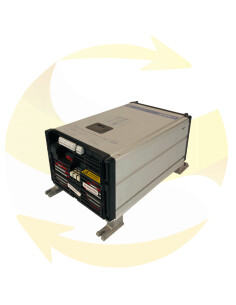
Engineered for precision speed regulation, the SMTBD1/1M-220/04 from the SMT‑BD1 series by INFRANOR is a PWM servo variable speed drive for sinusoidal brushless AC motors with resolver feedback. It features a ±10 V analog speed command, PI² speed loop with 0.5 ms sampling, programmable ramps, encoder emulation, and 4 A continuous current on a 270–340 VDC bus. Suitable for robotics, CNC auxiliaries, winding and conveying.

Reconditioned and tested systems
From 6 to 12
month warranty

New systems
From 12 to 24
month warranty

Reconditioned and tested systems
From 6 to 12
month warranty

New systems
From 12 to 24
month warranty

Sold for parts – no warranty

Repair will be made to damaged and defectiv units
From 3 to 18
month warranty


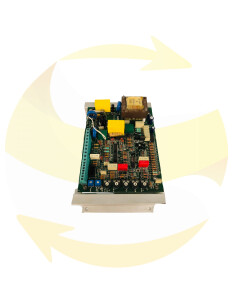
The SMTBD1/1M-220/04 is a variable speed drive module from the SMT-BD1 series by INFRANOR, designed for closed-loop speed and torque control of sinusoidal brushless AC motors using resolver feedback. This servo drive addresses applications where stable speed regulation, fast dynamic response and repeatable setpoint tracking are critical to process quality. Maintenance teams and machine builders will value its deterministic PI² speed regulator with a 0.5 ms sampling period, a standard ±10 V analog speed command interface, and auto-configuration functions that reduce commissioning time. Packaged in a 6U double Eurocard format with an IGBT power stage and DSP-based control board, the unit integrates easily in existing cabinets, supports parameterization via serial link, and stores configuration data in EEPROM for reliable power-cycle recovery.
The INFRANOR SMT-BD1 series is dedicated to servo applications requiring accurate speed control of brushless AC motors with resolver sensing. The platform combines a robust IGBT inverter stage with DSP-based regulation, ensuring deterministic loop timing and stable tuning across a wide operating envelope. Its DC bus architecture enables deployment on common DC networks fed by a front-end rectifier or shared across multiple axes, which simplifies multi-axis machines and reduces cabinet complexity. Standard analog setpoint handling allows straightforward interfacing with PLC analog outputs and motion controllers, while resolver feedback provides resilience in electrically noisy industrial environments and reliable rotor position information for field-oriented speed regulation. Encoder emulation further facilitates position capture or speed feedback for higher-level controllers and existing CNC systems.
Because the SMT-BD1 targets resolver-equipped brushless motors, it is relevant for environments where robust feedback is required, including high-vibration zones or areas with electromagnetic interference. The 4 A continuous current rating, in combination with the specified DC bus range, makes this drive suitable for small to mid-scale servo axes where accurate speed control is prioritized. When paired with matched motors and proper shielding, the drive helps maintain speed constancy under varying load, a key factor for uniform throughput and reduced scrap.
The SMTBD1/1M-220/04 variable speed drive integrates in a wide spectrum of motion tasks where speed stability and dynamic control translate directly into process performance.
Electrical integration typically involves connecting the drive to a 270–340 VDC bus supplied by a front-end rectifier or a shared DC link, routing three-phase motor leads to the output stage, and wiring the resolver. The ±10 V analog input accepts speed commands from PLC or motion controller analog outputs, while encoder emulation provides quadrature signals up to 8192 ppr for systems that require incremental feedback to higher-level control. Commissioning is performed via the serial link, with parameter sets saved in EEPROM to secure repeatable behavior after shutdowns. The programmable 0 to 30 s acceleration and deceleration ramps allow matching the drivetrain’s mechanical constraints and reducing inrush torques. Auto-tuning helps identify appropriate regulator gains, which is beneficial during maintenance interventions or motor replacements. When specifying this unit, select the motor and mechanical transmission so that nominal current remains within the 4 A continuous rating and the required top speed falls within the 100 to 14,000 rpm adjustable limit.
From a controls perspective, the closed-loop speed and torque functions based on resolver feedback make the SMTBD1/1M-220/04 a practical option wherever deterministic speed control is needed without implementing full position loops in the drive. In multi-axis machines, the module can be operated on a shared DC bus to improve energy efficiency through regenerative power sharing between axes, provided that the installation’s front-end and braking arrangements are designed accordingly. Shielding practices, proper grounding and cable segregation remain essential to preserve signal integrity for the resolver and the encoder emulation outputs.
This INFRANOR SMTBD1/1M-220/04 variable speed drive is available through Standard Exchange Industry in multiple service modes, including exchange, supply of refurbished or new units subject to stock, and repair of customer equipment. Each unit is functionally tested on a dedicated bench. Dispatch is organized within 24 to 72 hours to more than 120 countries. Our technical team assists with cross-referencing within the SMT-BD1 family and validates the compatibility of resolver wiring, DC bus conditions and current requirements. Deliveries are backed by warranty according to the selected service. If your production line is down, SEI can help identify the correct configuration and propose an equivalent reference within the SMT-BD1 range when necessary.